Insights, mindset shifts, and tools for the leader to be.

The foundations of social interaction and knowledge of how systems work are future-proof skills for addressing complexity.

Latest posts

Tensegrity Model: Your Body as a Memory Hard Drive

Where does intuition come from? What is the role of emotions in communication and decision-making? If you think you are mostly rational, surprise! Ninety-five percent of your decisions and actions are unconscious, emotional, or instinctive. Memory is a key element of decision-making. We learned that memory is stored in synapses through neural connections. The general…

Keep reading

Human nature, the why of things

Historians’s reports show that humankind evolved in the what and how, but not the why we do things. The “what and how” connected to the technology of things; the “why” connected to the moral motivations. Since the hunter-gatherer times, humanity went through historical revolutions in farming, industry, railways, electricity, internal combustion, information, artificial intelligence and…

Keep reading

Social credit, gossip on steroids

Recently, one of these superstars proposed that money will become irrelevant. This futurologist is also a billionaire. He predicts that robots and artificial intelligence will turn work into a hobby. Just like in a sci-fi movie, humans do not work, but technology takes care of all aspects of decision and production. What then shall replace…

Keep reading

Hope, the mother of engagement

Hope contradicts the claim that people don’t like change. In an earlier post, I criticized the Stoic concept of zones of influence and control. The current political environment favors those who stay in their tight zone of control. It reduces any effort to influence and challenge the status quo. This is happening all around us,…

Keep reading

If the Nobel Prize were an exam…

If the Nobel Prize were an exam, what would be the score of a laureate? Earlier, inTruth, What is it?, I hypothesized that science is the final arbiter between true and false. Religion, another source of truth, is now disrupted by technology. The question opening this post came to me after reading “Evaluating Large Language…

Keep reading

Social skills lead

Once upon a time I was a student. Sitting on the bench of a class I heard a pearl of wisdom from professor Wellington Penaforte. As a medical doctor, he taught me general physiology, but one single lesson stood out with me for many years: “In my many years of teaching”, he said, “I observed…

Keep reading

Paradox of scarcity: collaboration

Self-sufficiency is power. In organizations, it means the end of collaboration. Yves Morieux and Pieter Tollman have a pragmatic definition of power.  In a group, “[…] power is the possibility of one person to make a difference in what matters to another.  Power is the influence of managing or influencing uncertainties relevant to others.” *…

Keep reading

The dead horse syndrome

Recently, in my habitual LinkedIn scrolling routine, I see posts referring to the dead horse syndrome. The analogy refers to projects or strategies that require a huge amount of effort and investment, but does not move anywhere. Cases where hours are dedicated to looking at the horse in different angles, the amount of resources and…

Keep reading

Follow to lead

Harry Truman had a definition of leadership: “A leader has two important characteristics. First, he is going somewhere. Second, he is able to persuade other people to go with him.” Truman had these traits. He managed the Marshall Plan to rebuild Europe in the post-war period, broke the American isolationism of the early 20th century,…

Keep reading

Communication traits

Have you ever noticed that we all have a peculiar pattern of communication? The way we articulate thoughts, craft sentences, and inflect messages reveal who we are. Communication traits are clustered around personality types. Let me give you a funny example of what I mean. Pay attention to the masters of wisdom you know.  I…

Keep reading

Society in transformation

The relative peaceful and stable Western development of the past 80 years gave Boomers, Gen Xers and Millenials a false impression that society evolves in a linear fashion throughout History. In the bipolar world of the Cold War, the general affairs of geopolitics, economic development and trade were predictable. Many signs indicated the apparent linear…

Keep reading

Hero archetype, family stories

Much of my self-awareness came from observing my children grow older. Looking at them revives memories of my childhood and the influence family, friends, and community had on my formation. In Jungian psychology, archetypes emerge from the collective unconscious. This is not exoteric or metaphysical, but simply how psyche perceives and responds to life experiences…

Keep reading

Gender vs Generation

Gender equality changed the workplace in the Western world. Rightfully so. Yet, another element of change awakes in the horizon; the Generational characteristics will command change. In the next years, generation will replace gender in transforming the workplace. As time ages people, technology ages generations. The technological evolution renders ideas, methods, priorities, and values obsolete.…

Keep reading

Intuition, a superpower

Some people sense things and anticipate events. Especially events sparked by human action. A candidate has a perfect résumé and education profile for the job, but you sense something doesn’t quite match. The suspect tells agents how the heist unfolded, but they perceive the story is odd. Trained yogis can exit meditation at a precise…

Keep reading

Book critique

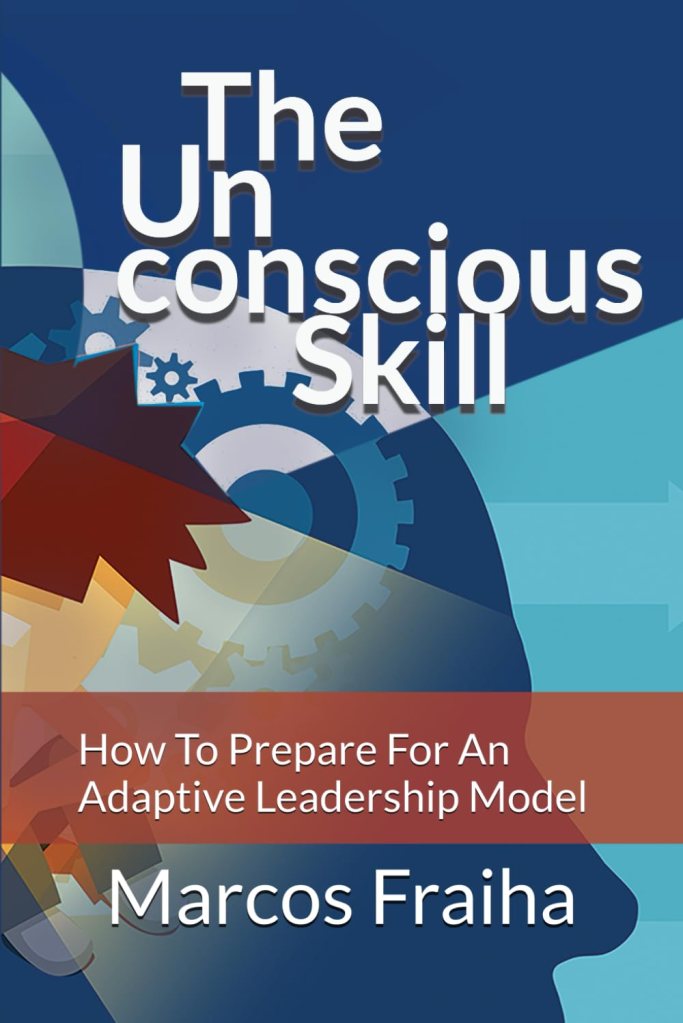
I have asked one of these LLM tools, a.k.a AI, for a critique review of The Unconscious Skill. The output came below: “The book’s standout idea is that true mastery in leadership and decision-making often operates below conscious awareness—what Marcos calls “unconscious skill.” It argues that high-performing leaders don’t just rely on deliberate reasoning; they…

Keep reading

Context is a powerful driver

Humans began farming 12.000 years or so ago, in many places across the globe. Cultivation of barley, wheat, peas, and lentils, along with the domestication of sheep, goat, and pigs in the Fertile Crescent; rice and millet farming in East Asia; corn in Mesoamerica; potatoes and beans, along with llamas and alpacas raising, in South…

Keep reading

Impostor syndrome

Impostor syndrome is a recent term for a variant of low self-esteem. It refers to a persistent self-doubt about the individual’s ability to carry on and explain his or her own success. The first references to this mental distress appeared in the early XXI century, but skyrocketed in the past ten years. Books, counselling, and…

Keep reading

Is leadership for anyone?

The versatility expected from leadership nowadays is very rarely found in one single person. Looking back in History, I found none. Take the clichés commonly present in LinkedIn posts as an example of what the Western world expects from a leader: visionary, pragmatic, flexible, reliable, listener, decisive, patient, pragmatic, financially savvy, emotionally intelligent, people oriented…

Keep reading

Engagement, or lack of

Recently, I reencountered a former colleague who worked with me. We had not seen each other for a couple of years after she moved to a new organization. She is a bright young talent with social skills, pragmatic, and capable of learning and adapting to the circumstances. We worked together on several projects, experimenting with…

Keep reading

Centralization or Decentralization?

A recurrent dilemma that plagues managers in charge of designing organograms: Should decisions be centralized or decentralized? Different industries will favor one decision-making model over another. Capital-intensive, heavily regulated, high-tech, or commodity industries may benefit from centralized decision-making. For instance, decisions of portfolio selection, pricing, R&D, and target markets can be centralized in pharma, healthcare,…

Keep reading

Truth. What’s it?

Hard science and religion were the ultimate sources of truth until recently. By hard science I mean the frontiers of knowledge that can be observed, hypothesized, and falsified following the scientific method. By religion I mean any belief system around abstract social constructions, uniting people toward a goal or mission. In that definition, physics, chemistry,…

Keep reading

Authoritarianism in disguise

Vanity is a form of stupidity. In the current era, when political leaders, successful businesspeople, athletes, and artists behave like celebrities, rationality takes a backseat. A recent event, in Europe, to discuss the prospects of war is an example of abundant vanity. The gathering to discuss plans to revive the armament industry and strategies for…

Keep reading

A kaleidoscope for leadership

As an apprentice to leadership, I learnt to use binoculars as the preferred tool for the archetypal leader who projects sight far and ahead. I now realize that a kaleidoscope is a more suitable tool for future apprentices dueling with complexity.

Keep reading

Meet Marcos Fraiha

Born in Brazil, now rooted in the Netherlands, Marcos has built his career in agribusiness —multinationals, family enterprises, and cooperatives. His most profound lessons on leadership come from mentoring and coaching managers across cultures and industries.

With business experiences spanning 45 countries, Marcos has seen firsthand how diverse values and contrasting paradigms shape decisions.

Fluent in Portuguese, English, Spanish, French, and Dutch, Marcos thrives on connecting ideas and people. He holds an MBA in Business Management and a Doctor Scientiae degree in Agricultural Engineering.

Motivation for journaling: Rationality alone in a complex world is insufficient; emotional intelligence, empathy, and intuition are hidden superpowers that unlock success. Writing favors reflection and self-awareness.